Damp Forest
A 3.5 m² family bathroom in Sofia
Every project at HOLOVERA SPACES begins with the same question: what does the body need this room to do? Not what it should look like, not what's trending, not what the catalogue suggests - what the nervous system, the senses, and the daily rhythm of the people inside actually require. The studio's methodology rests on five pillars - sensory experience, neurodesign, salutogenic design, smart solutions, and inclusive design - and Damp Forest is where all five had to work at once, inside three and a half square metres, for a family of two parents and three small children.
The brief was deceptively simple: replace a tired, functional bathroom with something the whole family could share without friction. The constraint - the size, the daily use, the three small bodies still learning how to move through a wet room - meant nothing could be decorative-only. Every surface, fitting, and proportion had to do regulatory work.
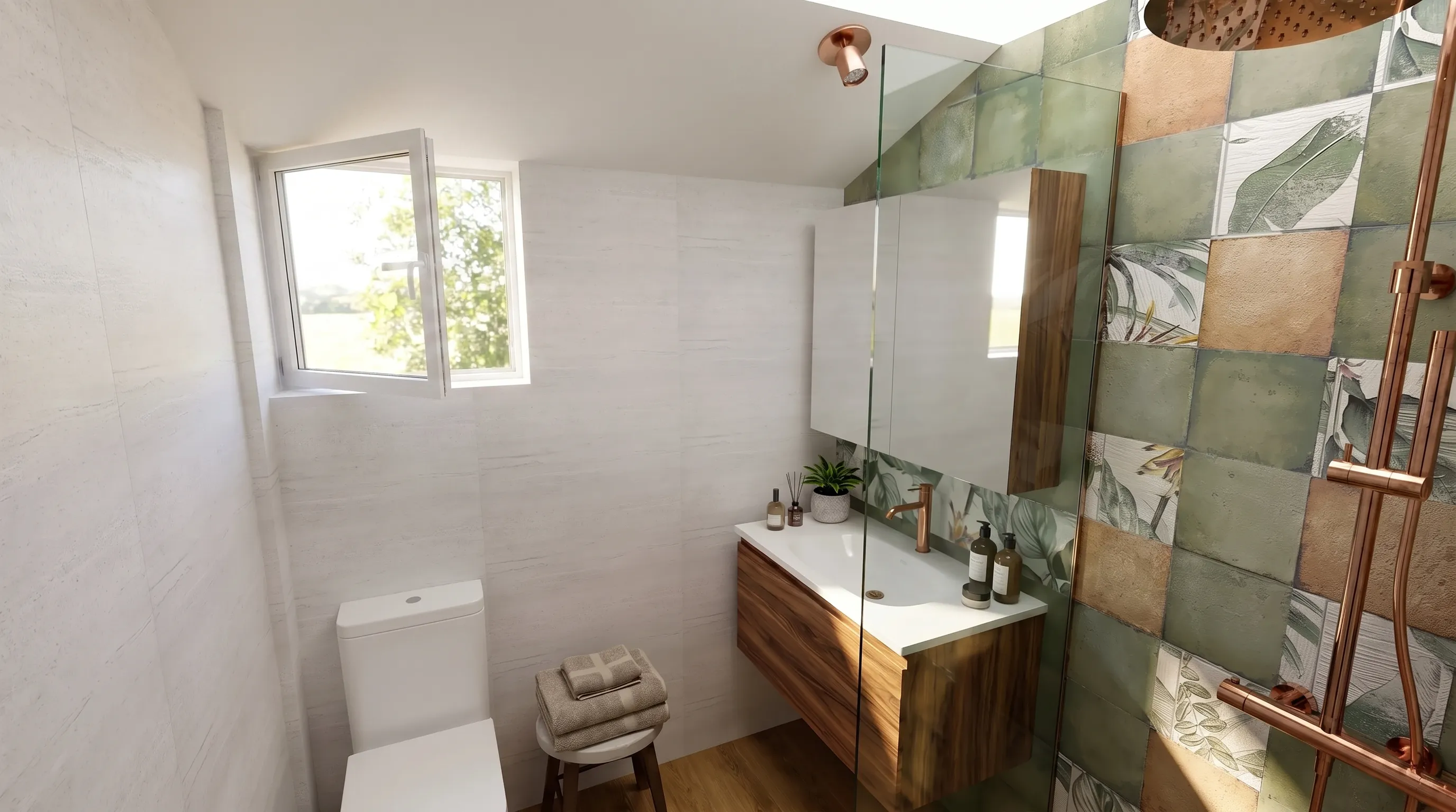
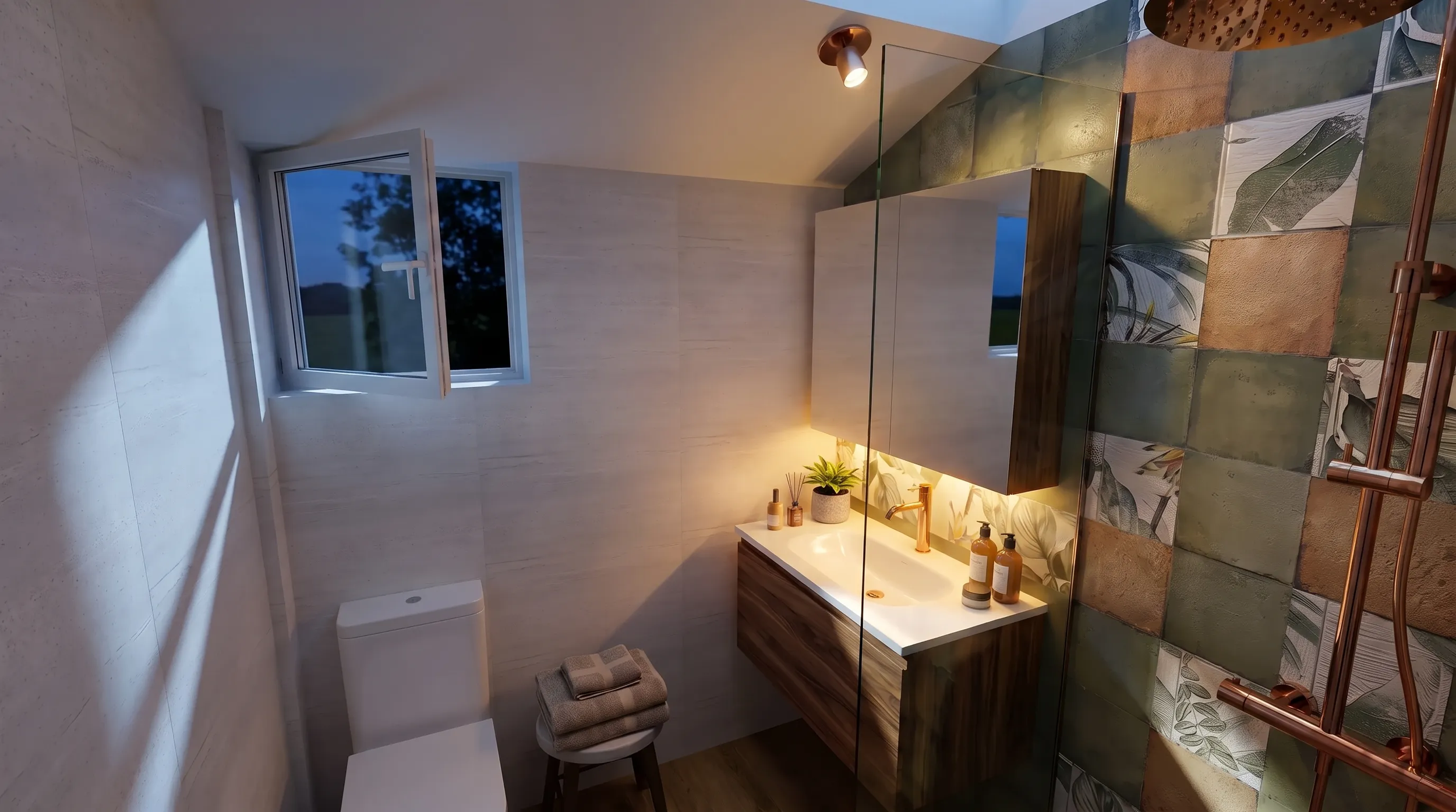
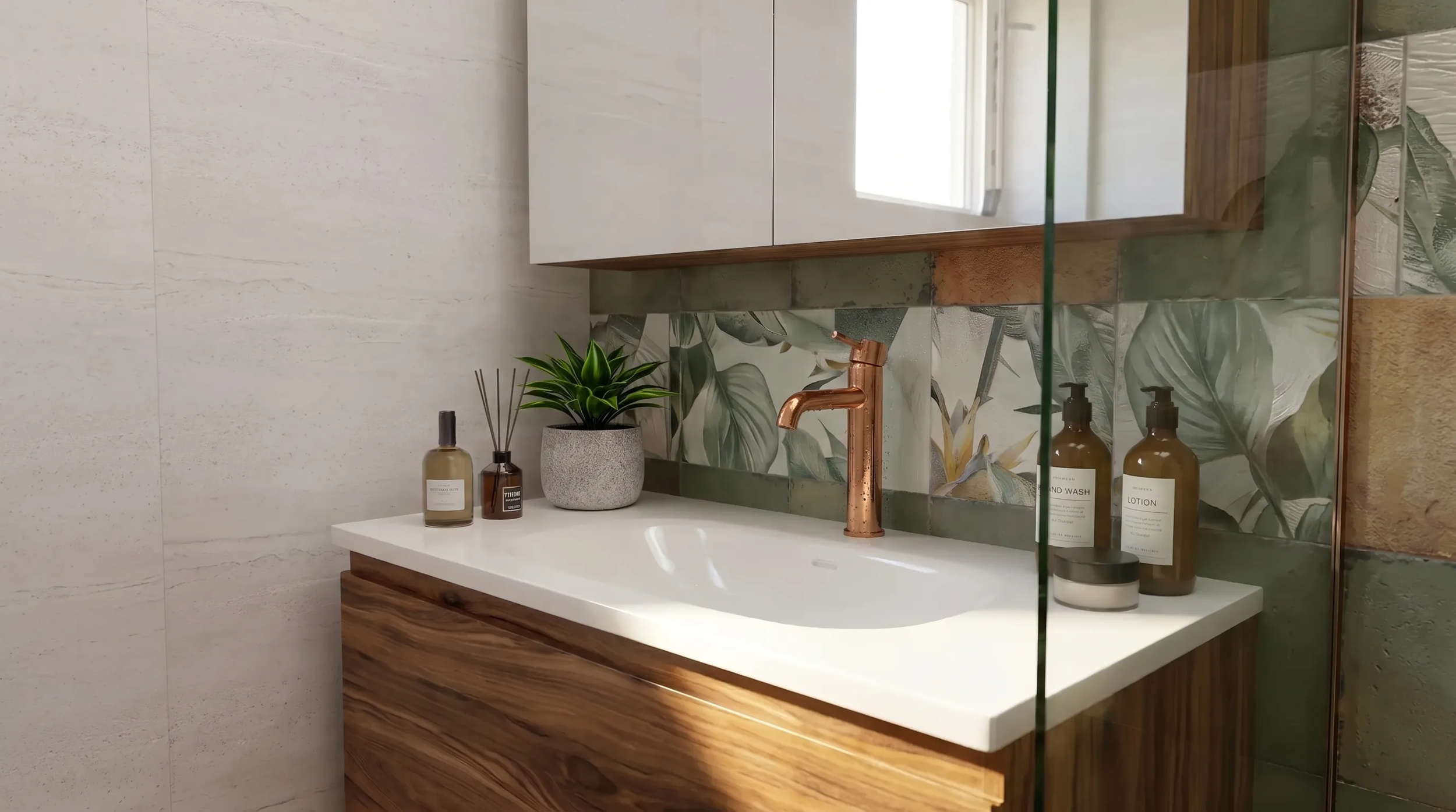
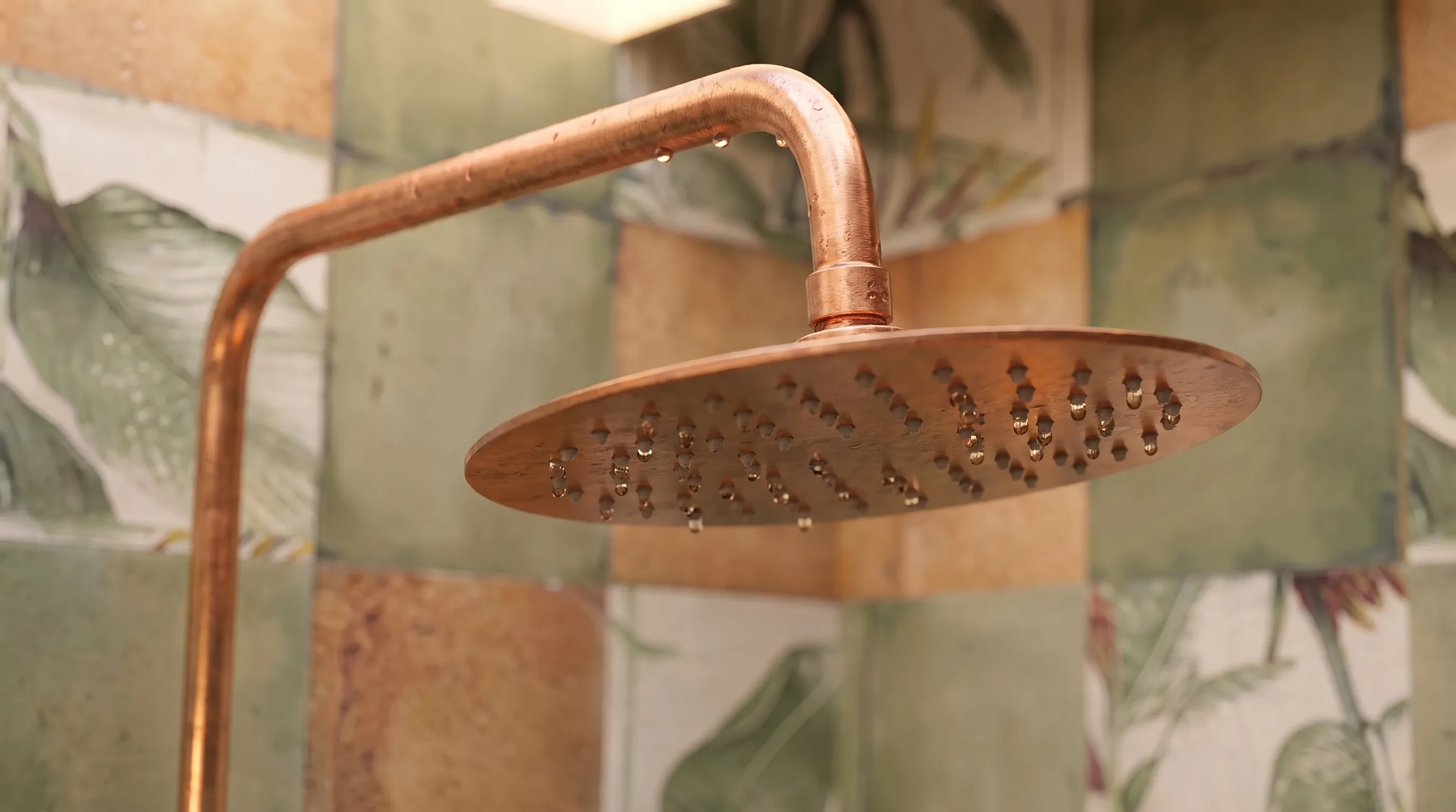
Sensory experience set the palette before anything else was decided. Forest green zellige, amber wood-look porcelain, walnut veneer, copper fittings, a botanical patterned tile reading as filtered light through leaves. Natural tones in this range are read by the visual cortex as low-threat, allowing the parasympathetic system to take over within seconds of entering the room. For a household where bath time is one of the few daily reset points, that shift matters more than any single design feature.
Neurodesign shaped the patterned wall. The botanical tile carries fractal geometry - the same mid-complexity natural patterns that Richard Taylor's research has linked to measurable stress reduction. The eye recognises these structures as familiar and safe, even without conscious attention. Around the fractal field, the rest of the surfaces are kept calm: a soft off-white wall finish, an unfussy mirror cabinet, an uninterrupted floor. The contrast lets the patterned wall do its work without competing.
Salutogenic design governed the floor and the shower. Wood-look porcelain with an anti-slip rating was specified over a more obviously "premium" finish — the felt sense of physical safety is the precondition for any nervous system to relax, and in a home with three small children that is non-negotiable. The shower is walk-in: linear drain, no threshold, glass partition. No barrier to trip over, no edge to lift a child across. Safety here is invisible by design, which is how it should be.
Smart solutions absorbed the storage problem. A wall-hung walnut vanity keeps the floor visually continuous and easier to clean. A mirror cabinet replaces the more common open shelf, hiding everyday clutter behind a flat reflective plane. A single open niche inside the shower holds only what's used daily. The result is a room with very little visible "stuff" — and a corresponding drop in the cognitive load of simply walking into it.
Inclusive design quietly underwrites the whole layout. The threshold-free shower works for a three-year-old learning to wash independently and for a grandparent visiting for the weekend. The vanity height accommodates a step stool without rearrangement. The copper fixtures - chosen for their warm, recognisable tone - function as visual anchors that help small children orient themselves in the room. Nothing is labelled "for kids" or "for accessibility." It just works for everyone who walks in.